AI Agent vs AI Assistant: What Is the Difference?
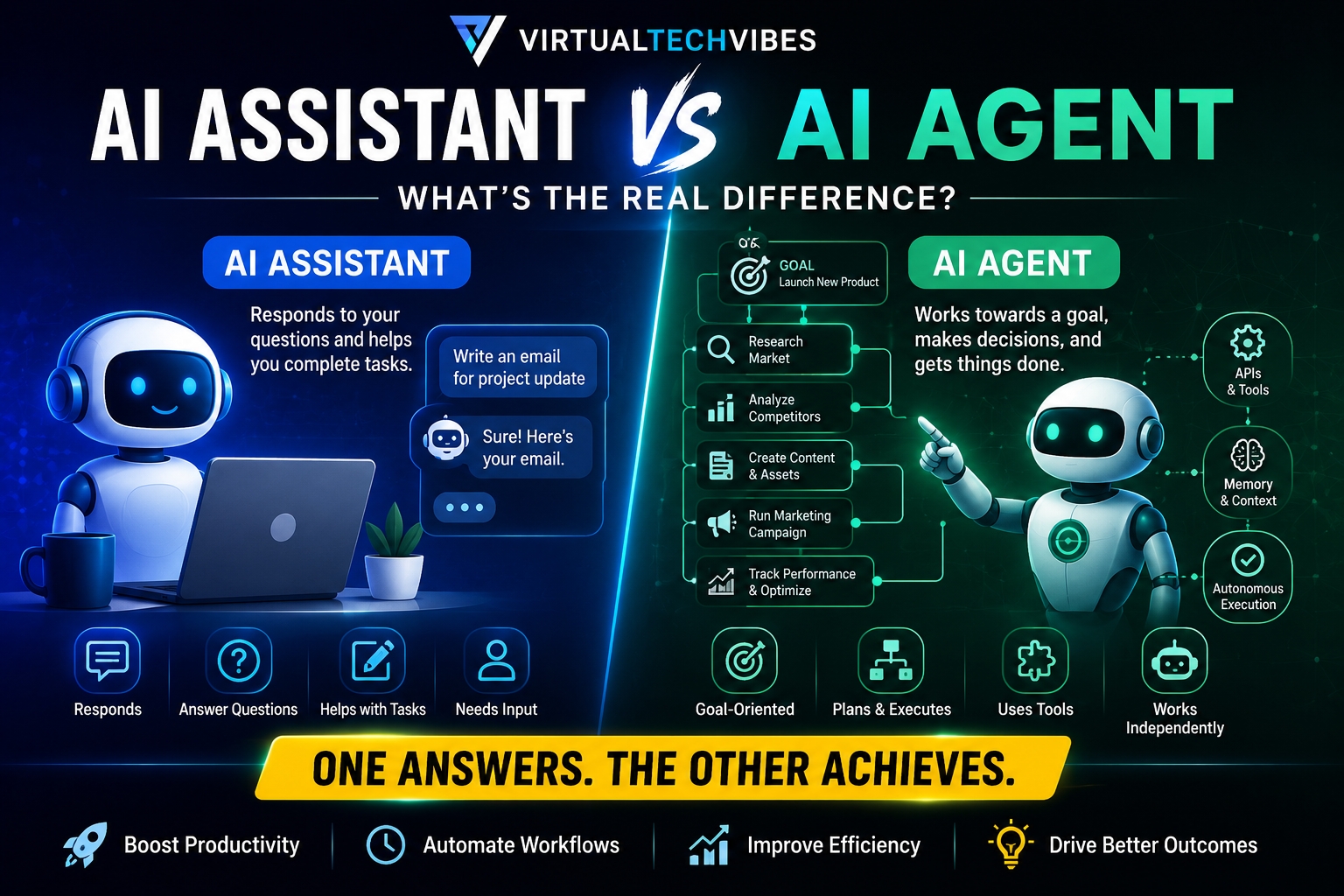
An AI assistant responds to direct user instructions and helps complete specific tasks, while an AI agent can independently plan, make decisions, use tools, and execute multiple steps toward a defined goal.
In simple terms, an AI assistant helps you perform a task, whereas an AI agent works toward completing an outcome.
For example, an AI assistant can write a product description when asked. An AI agent can research competitors, prepare the description, create a campaign plan, and track the launch with less human supervision.
This distinction matters to developers, startups, businesses, and technology leaders deciding whether they need conversational assistance or goal-based automation.
In this guide, we’ll define AI assistants and AI agents, compare their capabilities, examine practical examples, and explain when each approach is most useful.
What Is an AI Assistant?
An AI assistant is software designed to help a user complete specific tasks in response to direct instructions or questions.
It typically waits for a request, processes the instruction, and returns a response. The user remains in control of the workflow and usually provides a new prompt for every major step.
Popular examples include ChatGPT, Microsoft Copilot, Google Gemini, Siri, and Alexa. Depending on their configuration, these products may also contain agent-like features, but their familiar assistant experience is primarily conversational and user-directed.
Common AI Assistant Tasks
- Answering questions
- Writing or editing emails
- Summarizing documents
- Explaining and generating code
- Translating languages
- Creating presentations
- Brainstorming ideas
An AI assistant is generally reactive: it helps when asked and waits for the next instruction.
What Is an AI Agent?
An AI agent is a goal-oriented system that can plan a sequence of actions, make decisions, use tools, and execute connected tasks with a degree of autonomy.
Instead of returning only one response, an AI agent can continue working toward an objective. Its level of independence depends on the permissions, tools, safeguards, and approval rules established by its developers.
An AI agent may be able to:
- Break a goal into smaller tasks
- Select an execution path
- Use external tools, databases, and APIs
- Retrieve and analyze information
- Generate reports or other deliverables
- Monitor progress and results
- Adapt its plan when conditions change
- Request human approval for sensitive actions
An AI agent focuses on progressing toward an objective rather than merely responding to isolated commands.
AI Assistant vs AI Agent: Key Differences
| Capability | AI Assistant | AI Agent |
|---|---|---|
| Primary purpose | Helps a user complete specific tasks | Works toward a defined goal or outcome |
| Operating style | Mostly reactive | Can operate proactively within its permissions |
| Task scope | Usually handles one requested task at a time | Can coordinate multiple connected tasks |
| Planning | Relies heavily on user direction | Can create and adjust a multi-step plan |
| Tool use | May use tools when explicitly requested | Can select and use approved tools during execution |
| Context and state | Often limited to the current conversation or task | May maintain workflow state and longer-term context |
| Human involvement | Requires frequent instructions | Can operate with less intervention, with oversight |
| Best suited for | Interactive productivity and support | Automation and goal-based workflows |
The key difference is simple: an AI assistant helps you complete tasks; an AI agent helps you achieve outcomes.
A Real-World Example
Imagine that you own an online business and want to launch a new product.
Using an AI Assistant
You ask the assistant: “Write a product description.”
The assistant produces a description. If you also need competitor research, pricing ideas, social posts, and an email campaign, you provide separate instructions for each task.
Using an AI Agent
You give the agent a broader objective: “Prepare a launch plan for this product.”
Within its approved access and safeguards, the agent could:
- Research competitors
- Analyze market trends
- Suggest pricing options
- Generate product descriptions
- Create social media drafts
- Prepare marketing emails
- Build a launch checklist
- Track campaign performance
The assistant completes requested tasks individually. The agent coordinates connected tasks around the larger business objective.
How Do AI Agents Work?
AI agents commonly follow an iterative workflow:
- Understand the goal: Interpret the requested outcome, constraints, and success criteria.
- Create a plan: Break the objective into smaller, manageable tasks.
- Select tools: Identify which approved APIs, databases, applications, or models are required.
- Execute actions: Perform tasks and collect results.
- Evaluate progress: Compare results with the goal and detect errors or gaps.
- Adjust the plan: Retry, change strategy, or request human input when necessary.
- Complete or escalate: Deliver the outcome or hand the task to a person when limits are reached.
This cycle makes agents useful for workflows that require coordination, tool use, and repeated decision-making.
Real-World Applications
Common AI Assistant Use Cases
- Writing and editing content
- Learning programming concepts
- Answering questions
- Coding assistance
- Creating documentation
- Language translation
- Interactive customer support
Common AI Agent Use Cases
- Customer onboarding workflows
- Automated research and monitoring
- Sales and lead qualification
- Project coordination
- HR and recruitment workflows
- Financial reporting
- Software testing
- DevOps automation
- Business intelligence
When Should You Use an AI Assistant or an AI Agent?
Choose an AI assistant when the task benefits from an ongoing conversation, requires frequent human judgment, or can be completed through a small number of direct instructions.
Choose an AI agent when the objective involves several connected steps, repeated tool use, monitoring, or conditional decisions—and when appropriate permissions, testing, and human oversight are available.
For high-risk decisions involving finance, healthcare, employment, security, or legal obligations, human review should remain part of the workflow regardless of the system used.
Why Developers Should Care
Software development is moving beyond conversational AI toward agentic AI: systems designed to perform useful work across tools and workflows.
A development-focused agent may be able to:
- Read project requirements
- Create an implementation plan
- Generate an initial project structure
- Draft API documentation
- Suggest a database design
- Generate and run tests
- Review pull requests
- Recommend performance improvements
Developers therefore need more than prompt-writing skills. They also need to understand tool permissions, evaluation, observability, failure recovery, security boundaries, and human approval flows.
Explore VirtualTechVibes’ development services for implementation-focused product and software guidance.
Benefits of AI Agents
When designed and governed responsibly, AI agents can help organizations:
- Reduce repetitive work
- Increase team productivity
- Accelerate multi-step workflows
- Operate and monitor processes continuously
- Connect information across approved business systems
- Standardize repeatable processes
- Scale automation across departments
The value does not come from autonomy alone. It comes from combining reliable execution, clear boundaries, measurable outcomes, and appropriate human control.
Challenges and Limitations
AI agents can fail, misinterpret goals, select an unsuitable action, or produce incorrect information. Greater autonomy can increase both their usefulness and the impact of mistakes.
Important considerations include:
- Security and access control
- Privacy and data protection
- Hallucinations and incorrect outputs
- Tool and API integration failures
- Unexpected costs or repeated actions
- Compliance and audit requirements
- Monitoring, logs, and evaluation
- Human approval for critical decisions
Successful implementations use least-privilege access, controlled environments, clear stopping conditions, audit logs, testing, and responsible human review.
The Future of AI Assistants and Agents
AI products are evolving from search tools to assistants, agents, and coordinated multi-agent systems.
In a multi-agent workflow, specialized agents may divide responsibilities. One agent might gather information, another analyze it, a third generate code, and a fourth perform testing. An orchestration layer can coordinate their work and route important decisions to people.
This does not remove human responsibility. People still define goals, set permissions, validate high-impact results, and remain accountable for strategic decisions.
Which One Should You Learn?
If you are new to AI development, begin with assistants and learn:
- Effective prompting and context design
- AI-assisted coding
- Structured output
- Content generation
- Evaluation and fact-checking
Then move into agent development and explore:
- Agent orchestration
- Workflow automation
- Tool and function calling
- State and memory management
- API integration
- Guardrails and approval workflows
- Multi-agent collaboration
Key Takeaways
- An AI assistant responds to user requests and helps with specific tasks.
- An AI agent plans and performs connected actions toward a goal.
- Assistants are generally reactive; agents can be proactive within defined permissions.
- Agents require stronger security, monitoring, testing, and human oversight.
- The right choice depends on the workflow—not on which technology sounds more advanced.
- Developers who understand both approaches can build more useful and responsible AI products.
Frequently Asked Questions
What is the definition of an AI agent vs an AI assistant?
An AI assistant helps a user complete requested tasks, while an AI agent can plan and execute multiple connected actions toward a goal with a degree of autonomy.
Can an AI assistant become an AI agent?
Yes. An assistant can gain agent-like capabilities when developers add planning, persistent state or memory, tool access, decision logic, and controlled autonomous execution.
Are AI agents better than AI assistants?
Not necessarily. Assistants are often better for interactive, user-directed work. Agents are better suited to multi-step automation. The best option depends on the task, risk, available tools, and required level of human control.
Is ChatGPT an AI assistant or an AI agent?
ChatGPT is commonly used as an AI assistant. When connected to tools and configured to plan and execute multi-step work, a ChatGPT-based system may also provide agent-like capabilities.
Do AI agents work without humans?
Agents can complete some workflows with limited intervention, but responsible systems still require human-defined goals, permissions, monitoring, and escalation paths. High-impact decisions should include human review.
Can small businesses use AI agents?
Yes. Small businesses can use agents for controlled workflows such as lead qualification, reporting, scheduling, research, document processing, and customer support operations.
What is the biggest difference in one sentence?
An AI assistant helps you perform tasks; an AI agent works through tasks to achieve a goal.
Final Thoughts
AI assistants have transformed how people find information, create content, and complete everyday work. AI agents are extending those capabilities into coordinated, goal-oriented workflows.
The future is not simply about replacing assistants with agents. It is about choosing the right level of autonomy for each problem and designing systems with reliable execution, clear permissions, and meaningful human oversight.
Developers who understand both AI assistants and AI agents will be better prepared to build intelligent applications, automate complex workflows, and create the next generation of responsible software.
Continue Learning
Explore more practical AI, SaaS, development, cloud, and automation insights in the VirtualTechVibes blog.
About VirtualTechVibes
VirtualTechVibes publishes practical insights about artificial intelligence, software architecture, SaaS engineering, cloud computing, DevOps, cybersecurity, testing, and emerging technologies.