
Introduction
Artificial Intelligence has transformed the way developers write code, debug applications, create documentation, and solve technical problems. However, one important skill separates developers who simply use AI from those who truly maximize its potential:
Prompt Engineering.
A prompt is much more than a question—it is an instruction that guides an AI model toward producing accurate, relevant, and useful results.
Think of AI as a highly knowledgeable engineer joining your team. The quality of its output depends greatly on how clearly you communicate your requirements.
Learning Prompt Engineering isn’t about memorizing magic commands. It’s about learning to communicate with AI effectively.
In this guide, you’ll discover what Prompt Engineering is, why it matters, common mistakes to avoid, and practical techniques that every developer should know.
What Is Prompt Engineering?
Prompt Engineering is the process of designing clear, structured, and goal-oriented instructions for AI systems.
Instead of asking:
“Write login code.”
A better prompt would be:
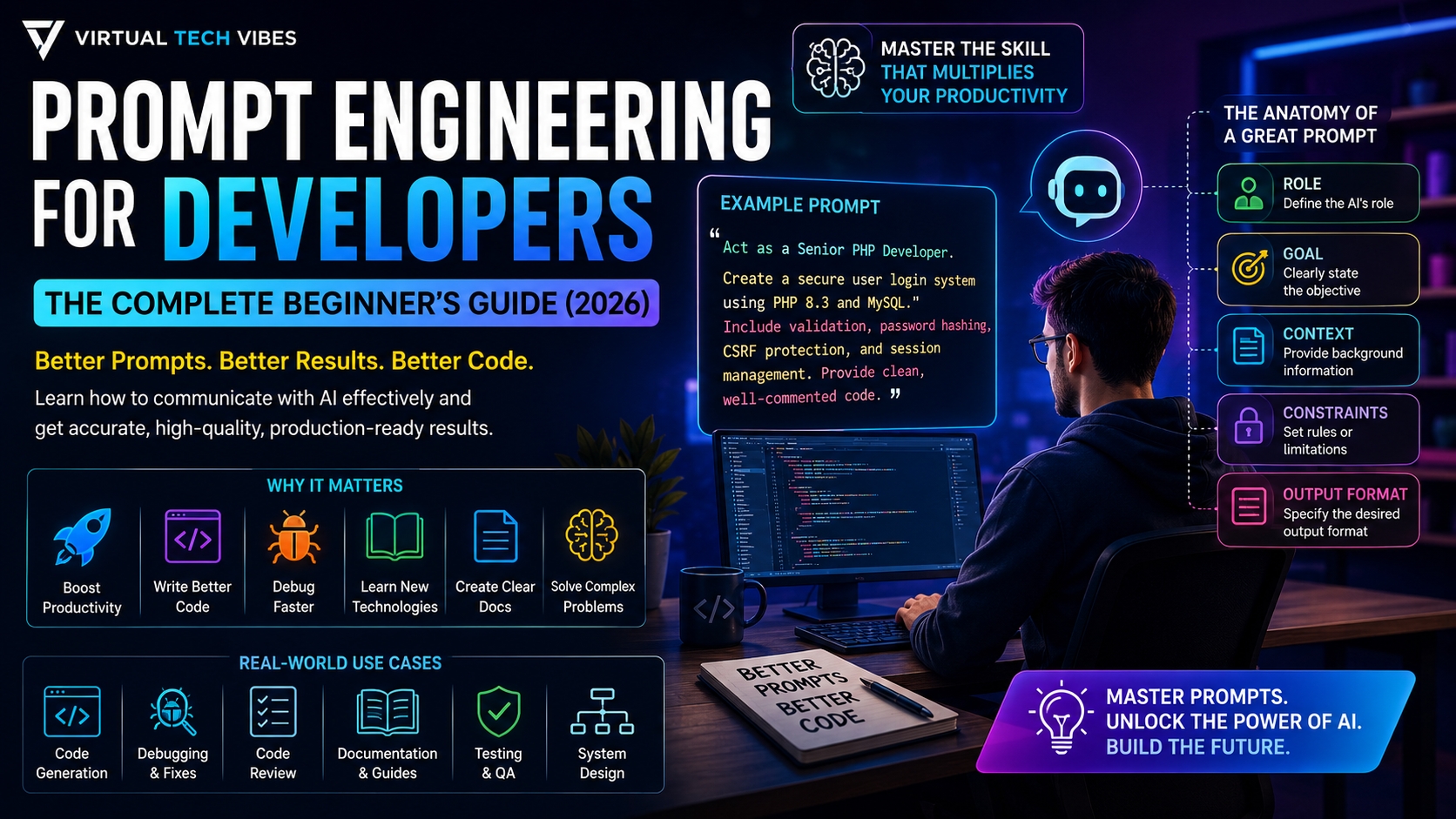
“Act as a senior PHP developer. Create a secure user authentication system using PHP 8.3 and MySQL with password hashing, CSRF protection, validation, and clean architecture.”
The second prompt provides context, role, requirements, and expectations—leading to significantly better results.
Why Developers Should Learn Prompt Engineering
Prompt Engineering helps developers:
Generate better code
Reduce repetitive work
Debug faster
Learn new technologies
Create technical documentation
Review code
Brainstorm architectures
Improve productivity
It becomes a multiplier for your existing technical skills.
The Anatomy of a Great Prompt
A high-quality prompt usually contains:
1. Role
Tell the AI who it should act as.
Example:
“Act as a Senior Software Architect.”
2. Goal
Clearly define the objective.
Example:
“Design a scalable SaaS authentication system.”
3. Context
Provide background information.
Example:
“This project uses Laravel, MySQL, Docker, and AWS.”
4. Constraints
Mention limitations or requirements.
Example:
Use REST APIs
Follow SOLID principles
Support 10,000 concurrent users
5. Output Format
Specify how you want the answer.
Example:
Step-by-step guide
Markdown
Table
JSON
Production-ready code
Poor Prompt vs Better Prompt
Poor Prompt
“Create a login page.”
Better Prompt
“Act as a Senior Full-Stack Developer. Build a responsive login page using HTML, Bootstrap 5, and JavaScript. Include client-side validation, accessibility best practices, and clean UI.”
The difference is clarity.
Prompt Engineering Techniques
Role Prompting
Assign the AI a role.
Examples:
Senior Developer
CTO
Security Engineer
Database Architect
UI/UX Expert
Chain-of-Thought Guidance
Break complex problems into logical steps.
Instead of asking for a final answer immediately, ask the AI to:
Analyze
Design
Compare
Recommend
Summarize
Few-Shot Prompting
Provide examples before requesting output.
Example:
Input:
Example 1
↓
Example 2
↓
Now solve this new problem.
Examples improve consistency.
Constraint-Based Prompting
Set clear boundaries.
Example:
Maximum 200 lines
PHP only
No external libraries
Mobile-first design
Iterative Prompting
Treat prompting as a conversation.
Version 1
↓
Improve
↓
Optimize
↓
Refactor
↓
Finalize
Professional developers rarely get the perfect answer from the first prompt.
Real-World Developer Use Cases
Prompt Engineering is useful for:
Code Generation
Generate boilerplate code and project structures.
Debugging
Explain errors and suggest fixes.
Code Reviews
Identify improvements, security concerns, and performance issues.
Documentation
Create API documentation, README files, and user guides.
Testing
Generate unit tests and edge cases.
Architecture
Brainstorm scalable system designs and compare approaches.
Common Prompt Engineering Mistakes
Being Too Vague
“Write API.”
Instead, explain the framework, language, authentication method, and expected output.
Ignoring Context
AI performs better when it understands your project.
Provide relevant details.
Expecting Perfection
Treat AI as a collaborator.
Review, test, and improve the output.
Skipping Verification
Never deploy AI-generated code without proper testing and validation.
Best Practices
Be specific.
Define the role.
Provide context.
Mention constraints.
Request structured output.
Iterate until satisfied.
Verify every technical response.
These habits consistently improve AI-generated results.
The Future of Prompt Engineering
Prompt Engineering is evolving rapidly.
Developers are beginning to work with:
AI Agents
Multi-agent systems
Tool calling
Memory-enabled AI
Workflow automation
As AI becomes more capable, prompt design will remain a valuable engineering skill because humans still define goals, priorities, and quality standards.
Conclusion
Prompt Engineering isn’t about learning secret commands.
It’s about communicating effectively with AI.
Developers who combine strong engineering fundamentals with well-designed prompts can work more efficiently, solve problems faster, and build better software.
As AI becomes an everyday development partner, Prompt Engineering will be an essential skill for software engineers, architects, technical leads, and founders alike.
Key Takeaways
Prompt Engineering improves AI output quality.
Clear context produces better results.
Role, goal, constraints, and format matter.
Iterative prompting delivers the best outcomes.
Human review remains essential.
Frequently Asked Questions
Is Prompt Engineering difficult?
No. It is a practical skill that improves with experience and structured thinking.
Do developers need Prompt Engineering?
Yes. It helps developers generate better code, documentation, and technical solutions while saving time.
Can Prompt Engineering replace programming knowledge?
No. Strong programming fundamentals are still essential for evaluating and improving AI-generated output.
Which AI tools support Prompt Engineering?
Most modern AI platforms, including ChatGPT, Claude, Gemini, GitHub Copilot, Cursor, and other AI coding assistants, benefit from well-structured prompts.
What is the most important Prompt Engineering tip?
Always provide context, define the role, explain the objective, and specify the desired output format.
Continue Learning
To deepen your understanding of AI-powered software development, read these related articles on VirtualTechVibes:
The Future of Software Development in 2026: Why Every Developer Must Learn AI
AI Agent vs AI Assistant: What’s the Real Difference?
15 Best AI Tools Every Developer Should Use in 2026
Together, these guides build a strong foundation for developers entering the world of AI-assisted engineering.
About VirtualTechVibes
VirtualTechVibes is dedicated to helping developers, architects, founders, and technology leaders master Artificial Intelligence, Software Architecture, SaaS Engineering, Cloud Computing, DevOps, Cybersecurity, and emerging technologies through practical, experience-driven technical content.